Oven Repair
Viking Oven Calibration and How to Tell It Has Preheated
Viking oven calibration starts with a thermometer test: if the average sits 25°F or more from the dial, shift the offset in the settings menu or at the thermostat knob. An oven 50°F off, or one that will not heat, has a failing part instead.
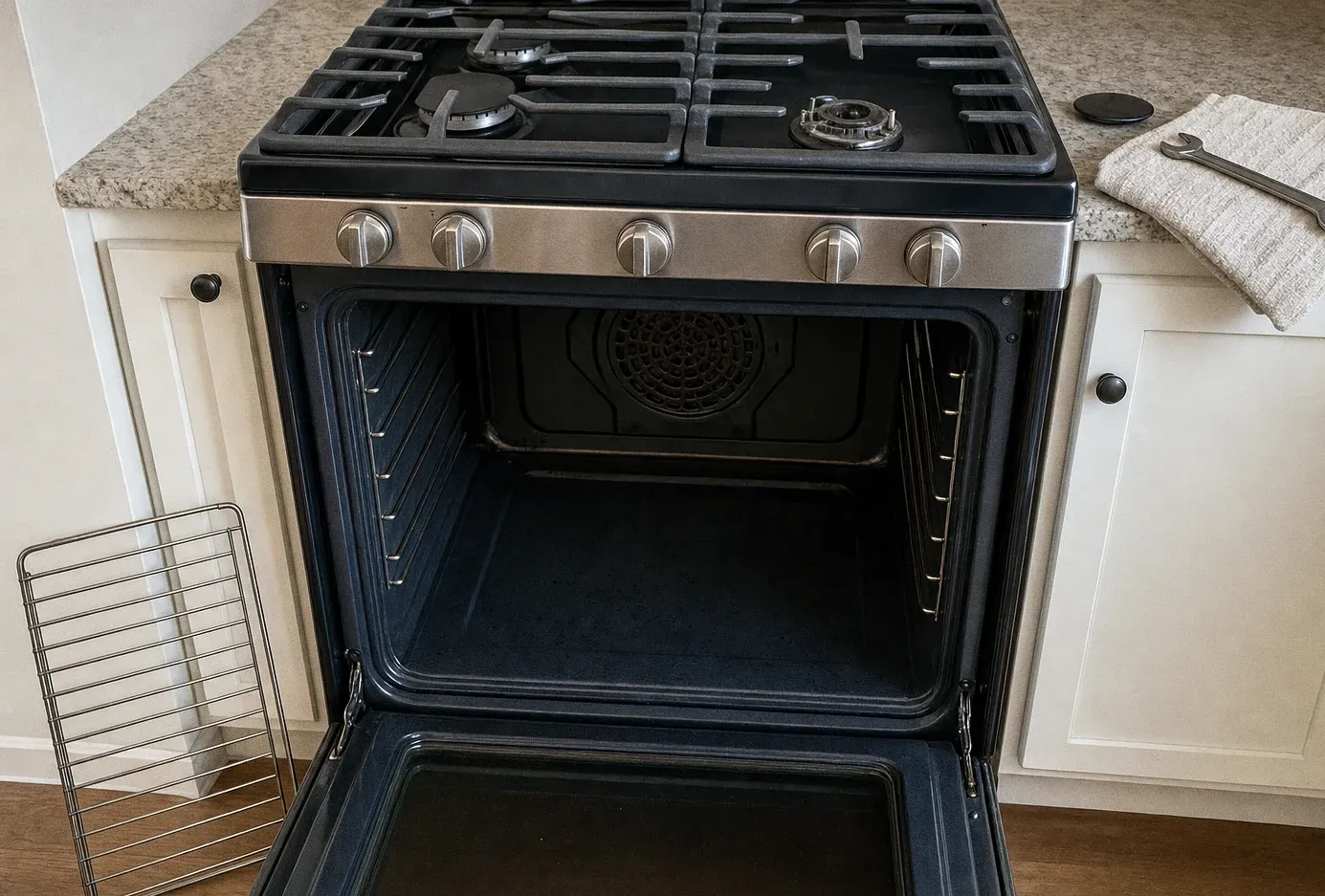
Viking oven calibration is a two-step job: first prove the oven really is off with a thermometer test, then nudge the offset, either through the settings menu on an electronic control or with the small adjuster behind the thermostat knob on older models. Set the oven to 350°F, put a thermometer in the middle of the center rack, and read it through the window for half an hour after the preheat signal. If the average lands within about 15°F of 350, leave it alone. If it sits 25°F or more away and stays there, adjust it. If it is 50°F out, drifts from day to day, or never gets near the setting, a part is failing and no adjustment will help.
That distinction matters on a Viking. These are heavy, well-insulated cavities that come up to heat slowly and then hold it, so a cook who opens the door the moment the light goes out, or trusts a single reading, can easily decide a healthy range is broken.
How a Viking tells you it has preheated
Most knob-set Viking ranges have a small indicator light near the oven knob. It glows while the burner or element calls for heat and goes dark when the cavity reaches the dial setting, then cycles on and off as the oven holds temperature, which is how it is meant to work. Models with an electronic control show the climbing temperature on the display and sound a tone at the set point.
The signal reports the air around the sensor, not the racks or the walls, and in a large cavity the walls lag behind. Waiting another ten to fifteen minutes before a loaf goes in gives far more even results than trusting the light alone. An empty oven usually reaches 350°F in something like a quarter of an hour, convection a little quicker, and a stone or cast iron pan left inside slows everything down. If the light is still on after forty minutes with nothing inside, treat that as a symptom rather than a reason for patience.
Running a thermometer test you can trust
The built-in display cannot settle the question, because it reads the same sensor the control uses to decide when to heat. You need an independent reading, and an inexpensive oven thermometer from a hardware store is good enough.
- Leave one rack in the middle position and stand the thermometer at its center.
- Choose plain bake, not convection, at 350°F.
- Wait for the preheat signal, then another twenty minutes.
- Read the thermometer through the window every three or four minutes for half an hour, and write each number down.
- Average the highest and lowest readings.
A thermostat never holds one exact number; it lets the oven cool a little, fires, overshoots slightly and shuts off again. A spread of a few dozen degrees is ordinary on gas, and electric ovens run tighter, so judge the middle of the band. Opening the door spoils the next several readings, so shine a flashlight against the glass instead. If you mostly roast, repeat the test at 425°F. An oven that is close at one setting but badly cold at another has a control or sensor problem, not a calibration one.
Making the adjustment
On a Viking with electronic controls, the temperature offset usually sits in the user options menu and shifts every bake setting by the same amount. The button sequence differs between product lines and generations, so follow the owner’s manual for your model rather than guessing. Move the offset by what your test showed, let the oven cool completely, and retest the next day before changing it again.
Older ranges with a mechanical thermostat are adjusted at the knob. Pull the oven knob straight off its stem; many have a small screw inside the hollow stem or a calibration ring on the back of the knob, and a fraction of a turn moves the temperature noticeably. Mark the starting position with a felt pen first, make small moves, and stop if the screw will not turn freely, because forcing it can damage the thermostat.
Calibration only moves the reference point. It cannot strengthen a weak igniter, mend a cracked element or seal a leaking door, and if you need more correction than the menu allows, the control is masking a fault that will keep getting worse.
When the number will not move
A slow, cold or uneven Viking oven nearly always comes down to a short list of parts, and which list depends on whether it burns gas or runs on electricity.
Gas ovens: the igniter comes first
Most Viking gas ovens light the bake burner with a hot surface igniter, a glowing bar that doubles as the switch for the gas valve, which opens only once the igniter draws enough current. As it ages the bar still glows orange but draws less, so the valve opens late or not at all. The pattern is distinctive: a long pause before the burner catches, a soft whoomp when it does, preheats that stretch past half an hour, and a temperature that sags as the bake goes on. Because the igniter looks fine to the eye, this fault is often mistaken for a bad thermostat.
Electric ovens: elements and the sensor
On electric and dual-fuel Viking ovens, inspect the bake and broil elements with the oven cold and switched off. A blister, a split, or a stretch that stays dark while the rest glows means the element is finished; where the bake element is hidden under the floor panel, a cold bottom and a hot top is the clue. The temperature sensor, a thin probe on the back wall, tells the control how hot the cavity is, and when it drifts the oven runs hot or cold by a growing margin. A technician checks its resistance against the chart for that model.
Heat that escapes, and pans that tilt
A worn door gasket, or a door that no longer closes square, lets heat out along one edge, which shows up as a long preheat and one side of the pan browning first. In Old Town, where many houses date to the 1700s, kitchen floors are seldom truly level, and a leaning range sends batter to one side in a way that looks like uneven heat, so put a spirit level on it before blaming the oven. If the trouble began right after a cleaning cycle, read our notes on Viking self-clean lockouts, since that heat can leave a control erratic or a thermal fuse open.
What the repair usually costs, and when to call
Call when the test shows an average about 50°F or more off, the oven cannot reach temperature, a preheat takes twice its usual time, an element sparked, or a gas smell lingers past ignition. If the smell persists, turn the oven off, open a window and call the gas utility before anyone else.
These are typical ranges, and the firm number comes once the fault is found. An oven thermostat or heating element usually falls between $250–$800, an igniter or burner assembly between $270–$660, and a control board or touch panel between $400–$870. Finding that fault starts with a $95 service call, and whatever you spent on it is subtracted from the repair once you tell us to proceed.
What an oven visit covers is set out on the oven repair page, and the number to call is (508) 785-6498. Have the model and serial number from the rating plate to hand, along with your thermometer readings. Those few numbers save guesswork and point straight at the part that needs attention.
Still asked on the phone
How do I know when my Viking oven is preheated?
On most Viking ranges the small indicator light beside the oven knob goes dark once the set temperature is reached, while electronic models show it on the display and sound a tone. The light then cycles on and off as the oven holds heat, which is normal. Give the cavity another ten minutes before baking, because the walls lag behind the air.
How far off can a Viking oven run before it needs calibrating?
An average within about 15°F of the setting is fine and needs no change. When it sits roughly 25°F to 50°F away and stays there from one day to the next, an offset adjustment is worth making. Beyond that, or if the error wanders, a part is failing and calibration would only hide it.
Why is my Viking gas oven so slow to preheat?
A tired hot surface igniter is the usual reason. It keeps glowing but draws too little current to open the gas valve properly, so the burner lights late and the oven struggles to reach or hold its setting. Igniter or burner assembly work typically runs $270–$660, with the firm figure given after diagnosis.
Can I calibrate a Viking oven myself?
Yes, in most cases, provided the oven is otherwise healthy. Electronic models keep a temperature offset in the settings menu, and many older knob models have an adjustment screw or ring behind the thermostat knob. Test with a separate oven thermometer first, change things in small steps, and retest from cold the next day.
Is an older Viking oven worth repairing?
Usually, yes, when the fault is an igniter, element, sensor or thermostat. A thermostat or element typically runs $250–$800 and a control board $400–$870, a small share of what a new Viking range costs. Finding the actual fault first, on a $95 visit, keeps you from paying for parts the oven never needed.